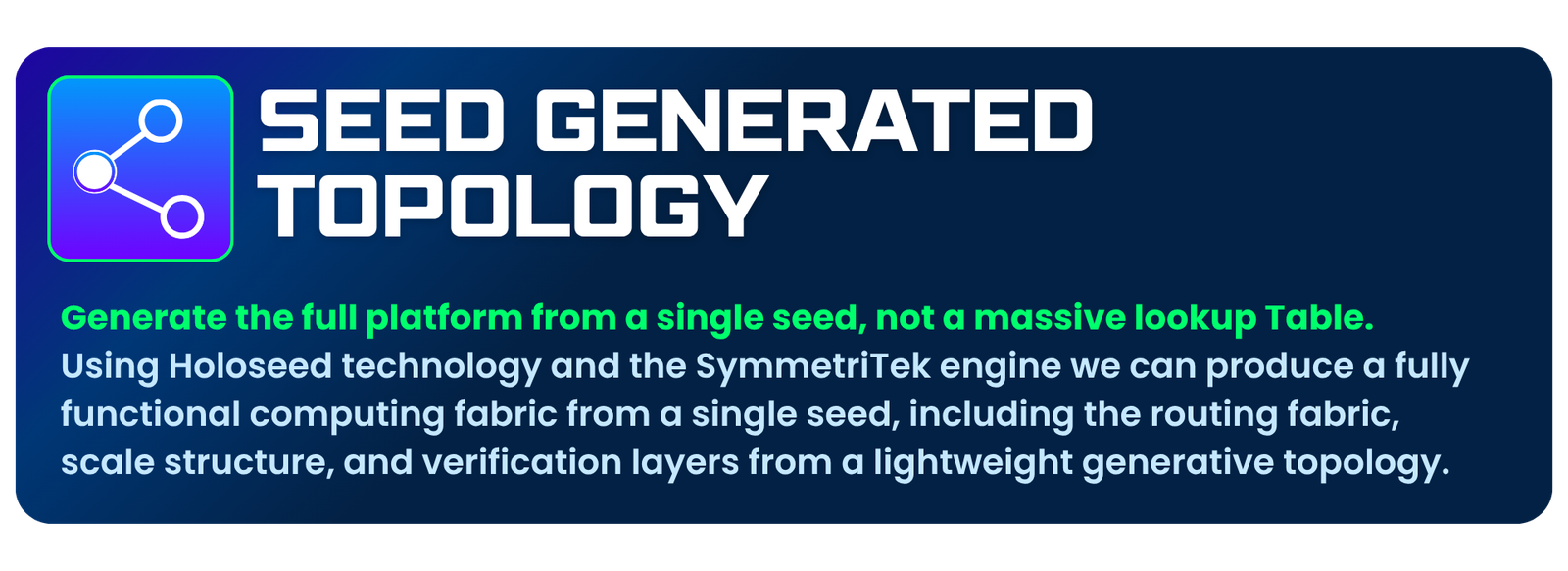
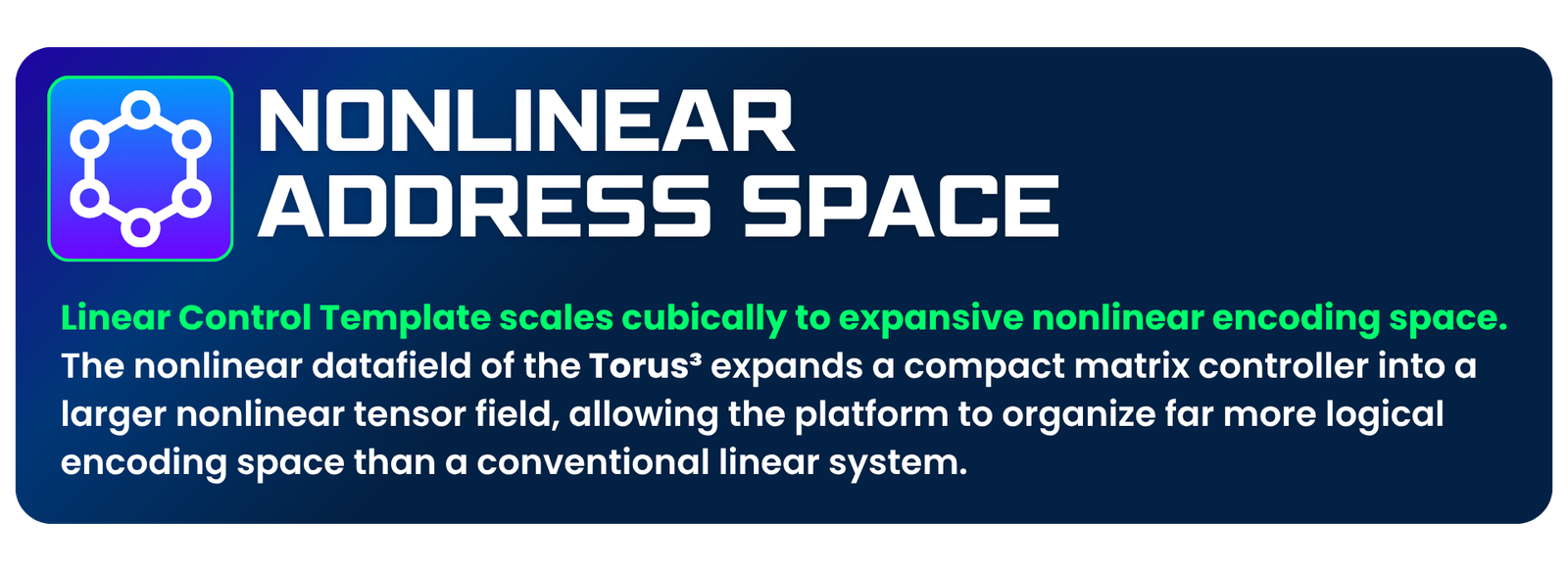
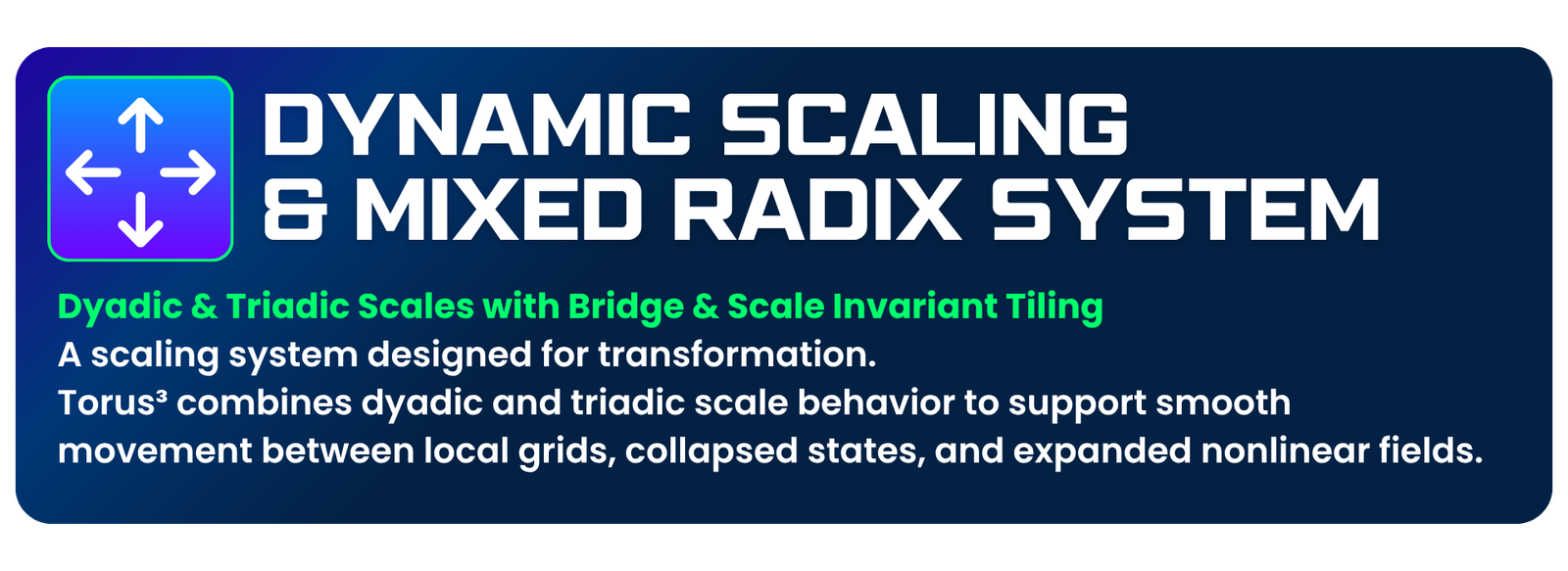
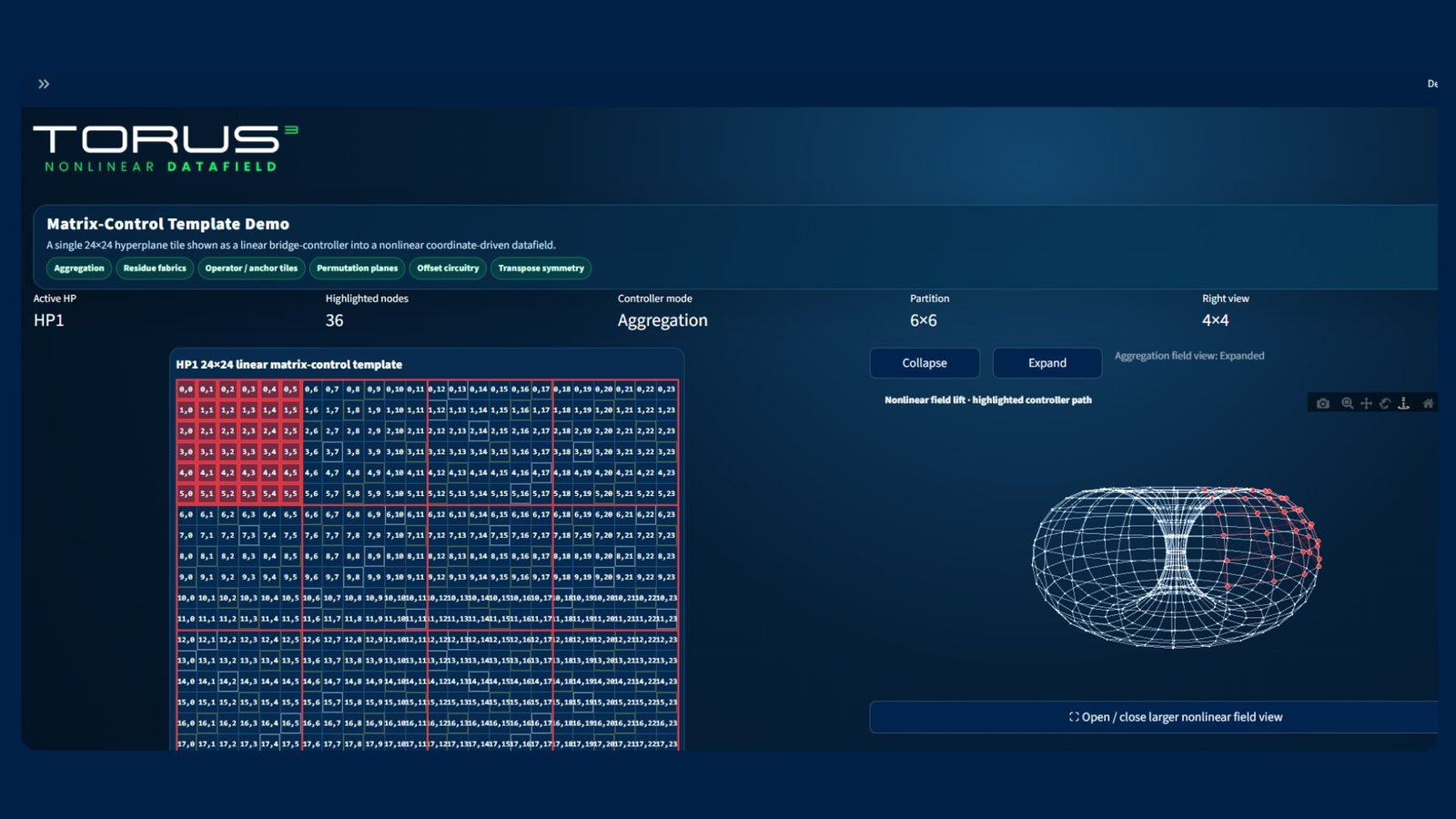
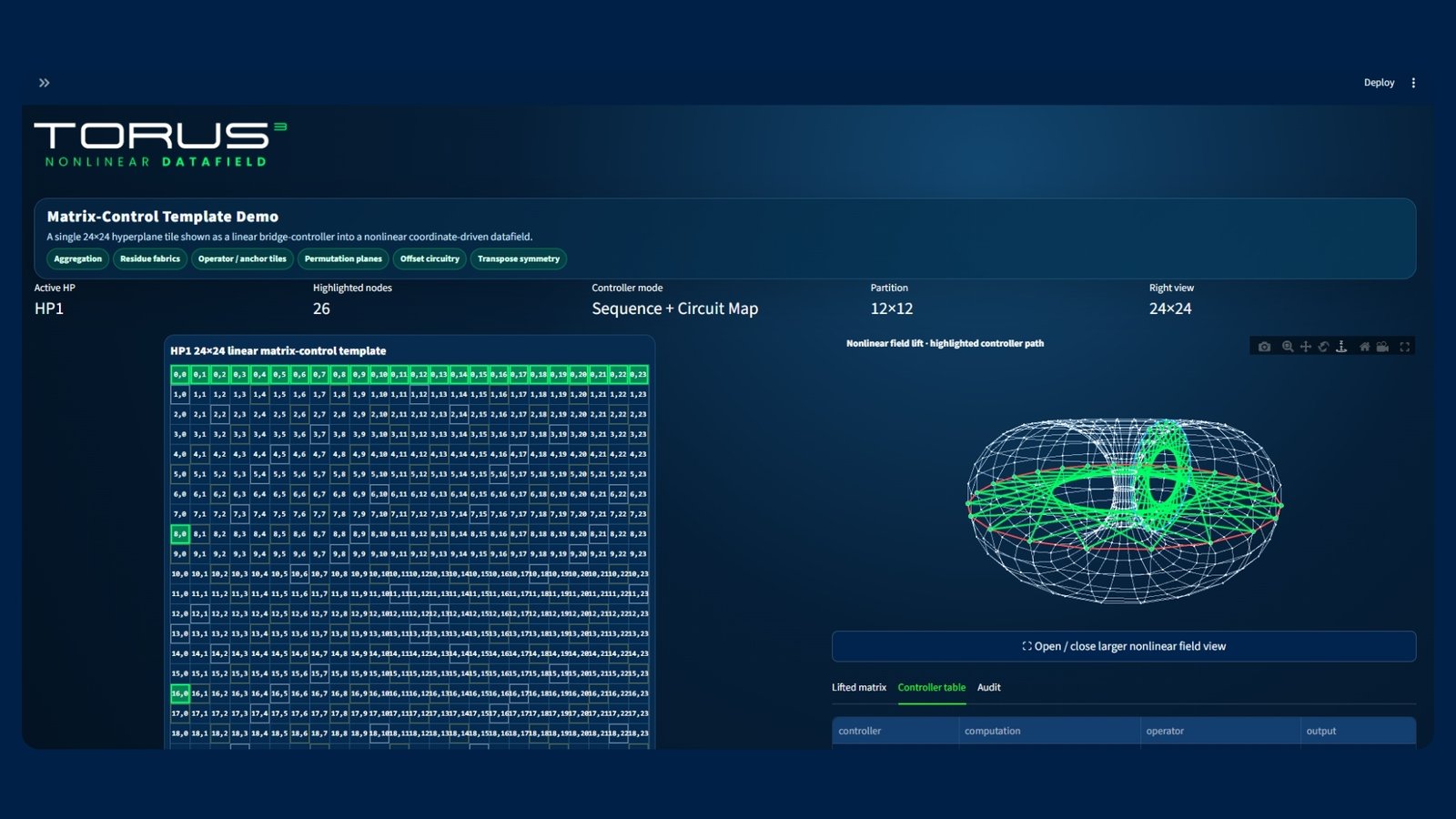
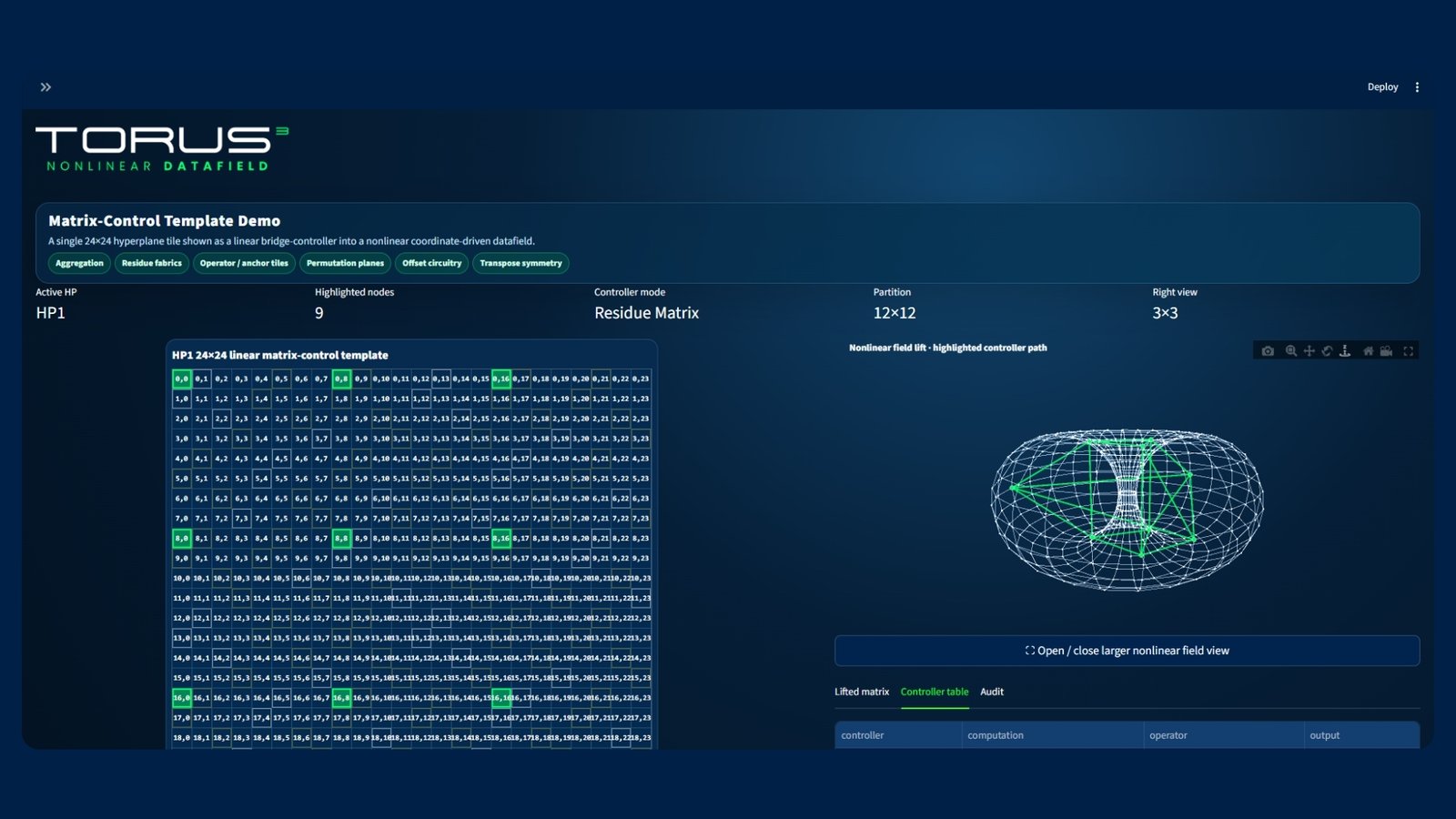
Holo-Geometric Computing is the architectural framework behind the Torus³ Platform, a generative, nonlinear topological computing fabric. This fabric consolidates the often disjointed computational layers of traditional linear systems into a single, unified mathematical structure. Through different perspective views of this algebraically closed structure, the platform enables hierarchical addressing, scale-aware routing, self-healing recovery, and consensus-driven verification. Governed by a closed family of matrix controllers and a finite set of universal kernels, the platform maintains a single control grammar to operate and audit all functional states of the system. Within this architecture, the collocated and embedded matrix controller acts as the linear interface to a braided multidimensional topological network or nonlinear datafield. Torus³ aims to minimize hardware complexity through a structure-first approach that utilizes geometric relationships to perform computation, with the goal of reducing the structural overhead and scaling bottlenecks that limit conventional linear von Neumann architectures. Grounded in first principles, the system relies on a mathematically validated algebraic framework, exhaustive programmatic verification, and ongoing developmental FPGA demonstrations of its core operations.
Computing Evolution
From room-scale machines to a generative seed.
Hardware became smaller. Interfaces became smarter. The next leap may begin as a compact structural grammar that unfolds into its own nonlinear computing field.
Stage 01 · HoloseedHoloseedA compact structural seed waits at closure. Activate it to regenerate the controller field.
Click Holoseed to repopulate
Drag to inspect 3D stages · select any stage below
SymetriTek™ is the master symmetry engine that enables the Torus³ topology to function as a self-referential, self-healing, and scalable network. It is the Master Key of the Nonlinear network activating it's full potential and performance. Achieved by way of HoloQuantum Dynamics which applies Quantum & Holographic Information principles to Topological & Classical Computing Systems.
A NEW STANDARD IS IN DEVELOPMENT
APPLICATIONS & USE CASES
STRUCTURE FIRST RECOVERY
ERROR CORRECTION
The HyperMaze system redefines fault tolerance through deterministic geometric encoding. Data is stored within fractal hyperplanes that mirror and entangle across layers, enabling entire matrices to regenerate from a single known node. Recursive logic cascades restore damaged structures, delivering high recovery rates even with extreme corruption, without relying on redundancy or backups.
TetraPoint™ Diamond Compression reduces data by folding hyperplanes into smaller tetrahedral cells, maintaining structural integrity and coordinate mapping. This geometric approach achieves 78-99% lossless compression, transforming large datasets into compact holographic seeds. Compressed structures remain fully reconstructible, enabling extreme data density without compromising fidelity.
HyperMaze™ processes information through dynamic hypergrids that reconfigure in real time. Nodes compress, expand, and route data simultaneously, reducing latency while preserving deterministic logic. This enables scalable analytics and transformation pipelines that self-optimize as data flows. This is ideal for high-throughput applications. This combines spatial and temporal compression techniques.
Diamond Mind AI is an R&D prototype exploring how Torus³ can give AI memory a more structured way to store, recall, and organize knowledge. Instead of loose text fragments, we place knowledge databases into a structured fabric where related concepts and retrieval paths are connected, allowing relevant databases to be accessed in two hops or less. After recall, the system can activate useful memory nodes while deactivating weaker pathways to help reduce drift, noise, and degradation bottlenecks.
HYPERWARE (N²oC) Nonlinear Network-on-Chip Routing Fabric is a R&D benchmarking prototype that uses a formula-driven routing footprint of roughly 7.5 KB versus Gigabytes for flat directory. In the Hyperware physical-stack proxy, 5,184 visible seats expanded into 4,976,640 logical addresses, while the route-family edge proxy used only 0.573% of full crossbar density all while maintaining a ultra-low 2.72/avg. route depth. Scaling utilizes a reindexing template that acts as both the space and the controller.
Hypermaze Encryption is a developing path authenticated encryption protocol built on the Torus³ Platform to add structural authentication to encrypted data access. It transforms a static key into a lawful path through a nonlinear address fabric, adding a dynamic geometric protection layer around the original secret. With over 100,000+ brute-force path attempts and no successful breaches, requiring the correct structural route to unlock and recover the payload.